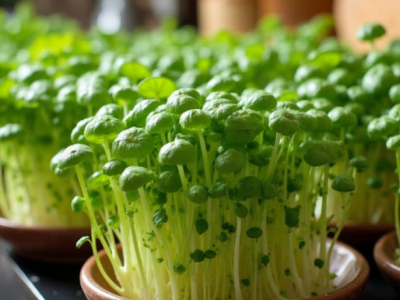
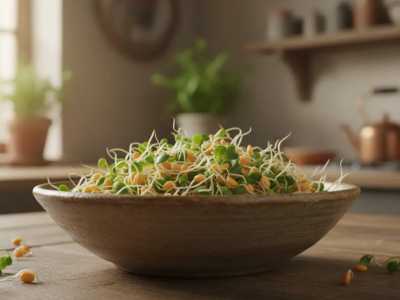
Used for over 4,000 years in the Mediterranean basin, fenugreek (Trigonella foenum-graecum) is both a familiar curry spice and one of the easiest legumes to sprout at home. When transformed into a sprout, it becomes a true living vegetable: its proteins are better assimilated, its antioxidants multiply, and its available mineral content increases. In this comprehensive guide, I explain the 4-day method, the 7 benefits proven by science in 2026, the precautions to know (pregnancy, diabetes, anticoagulants), and three recipes to incorporate it into daily life. For a broader overview of the world of sprouted seeds, you can also consult the complete guide to sprouted seeds by Éric Viard.
In brief — why sprout fenugreek?
A natural predigestion of proteins and fibers that improves assimilation.
Antioxidants multiplied by 56 to 76% compared to the dry seed.
A documented hypoglycemic effect (clinical meta-analyses on type 2 diabetes).
A significantly improved mineral bioavailability (calcium, magnesium, iron).
A simple and quick domestic method (4 days), even without specific equipment.
What is fenugreek and why sprout it?
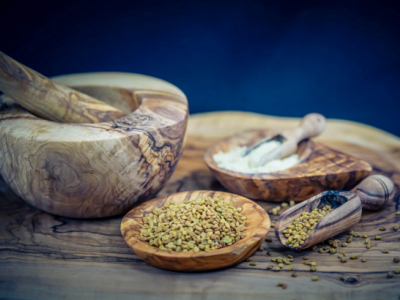
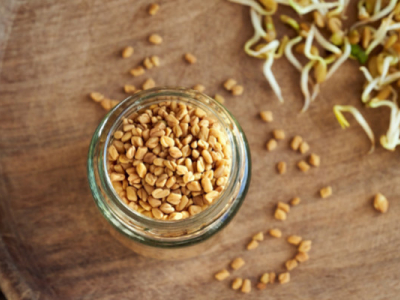
Fenugreek is an annual plant from the Fabaceae family (legumes), originating from the Middle East and cultivated around the Mediterranean for several millennia. Its small golden and angular seeds are part of Indian curry, Egyptian helba bread, and many traditional North African preparations.
Dry, the seed is a spice. Sprouted, it becomes a living vegetable. Through soaking and enzymatic activation, the seed's reserves are partially hydrolyzed: starch turns into simple sugars, proteins into shorter peptides, phytates (which block mineral absorption) are degraded, and the concentration of polyphenols, vitamin C, and active enzymes increases significantly. For an overview of this phenomenon, read our article on the benefits of sprouting seeds.
In practical terms, sprouting profoundly changes the nutritional profile of fenugreek:
Polyphenols increase from 2.0 mg/g to about 5.0 mg/g of dry matter (+150%).
Antioxidants increase by 56 to 76% according to measurements (Dixit study 2005).
Available calcium is multiplied by 2.8 and magnesium by 2.4 (Hussain study 2012).
Vitamin C, almost absent in the dry seed, becomes measurable in the sprout.
Phytates, antinutritional factors, are significantly reduced.
How to sprout fenugreek in 4 days (step-by-step method)
Fenugreek is one of the easiest seeds to sprout: high germination rate (often ≥ 95%), short cycle, few requirements. You can use a jar sprouter or an automatic sprouter, or even a simple tilted saucer.
Materials:
2 tablespoons of organic fenugreek seeds (about 25 g).
A sprouting jar with a screen or a clean strainer.
Fresh non-chlorinated water (filtered or spring water).
A room at 18-22 °C, in dim light (no direct sunlight).
Day 1 — Soaking (12 hours)
Rinse the seeds, place them in the jar, and cover them generously with fresh water (the seeds will swell 2 to 3 times). Let soak for 12 hours, or overnight.
Days 2 and 3 — Twice-daily rinsing and draining
Drain the soaking water, rinse thoroughly, then tilt the jar at a 45° angle to allow excess water to drain. Repeat morning and evening. The rootlets appear as early as the 24th hour. For the right techniques, see our foolproof tip for rinsing sprouted seeds.
Day 4 — Tasting (or day 5 for a more developed sprout)
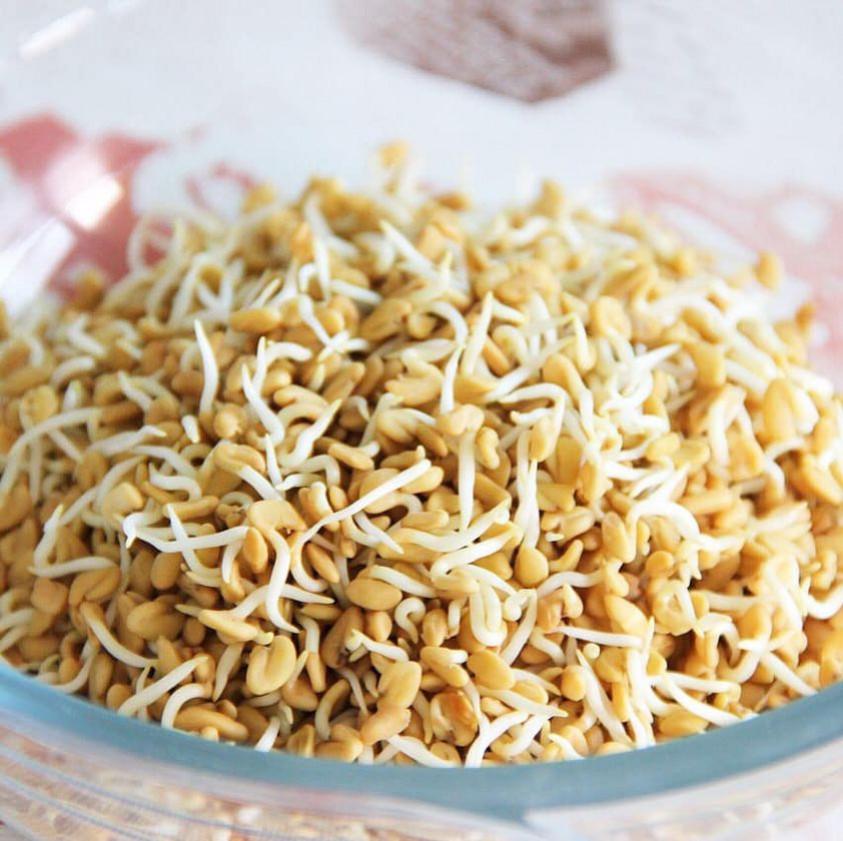
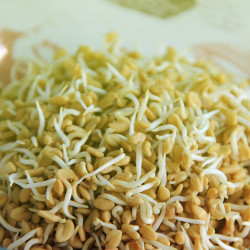
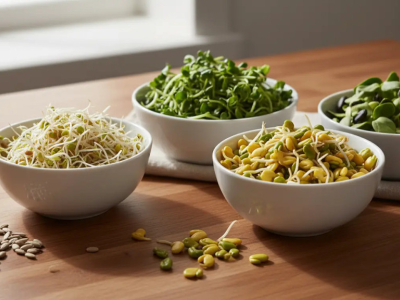
At 72-96 hours, the sprouts measure 0.5 to 2 cm and emit a subtle fragrance reminiscent of curry. This is the ideal time for consumption. Rinse one last time, drain, and store in the refrigerator in a ventilated container for a maximum of 3 to 5 days.
Signs of success: fresh slightly spicy smell, white sprouts with green tips, well-swollen seeds. Signs of failure: sour or ammonia smell, cottony filaments (mold) → discard without hesitation. To choose the right variety of seeds to sprout or to consult the recommended durations for other legumes, download the Biovie germination chart.
The 7 Proven Benefits of Sprouted Fenugreek
Sprouted fenugreek combines the properties of the dry seed (saponins, flavonoids, galactomannan) and the benefits specific to germination (bioavailability, polyphenols, enzymes). Here are the 7 most well-documented benefits. For a broader overview, also read our article 12 proven benefits of sprouted seeds for your health.
1. Complete proteins better assimilated
Dry fenugreek seeds contain about 23 to 27 g of protein per 100 g, according to Ciqual data. Due to germination, some proteins are predigested into shorter peptides, and the relative content of useful proteins can increase by 15 to 40% (Hussain 2012). The essential amino acids (lysine, tryptophan, 4-hydroxyisoleucine) are particularly interesting for vegetarians and athletes.
2. A clinically documented hypoglycemic effect
Several meta-analyses conducted on type 2 diabetic patients (10 to 14 pooled trials) report an average reduction in fasting blood glucose of 14 to 23 mg/dL, postprandial blood glucose of 21 to 23 mg/dL, and HbA1c of 0.6 to 1.2% with daily fenugreek supplementation. A study cited by the Compagnie des Sens shows that a daily intake of 5 g for 3 months lowers HbA1c by 0.88 ± 0.7% on average.
3. An Improved Lipid Profile
A meta-analysis of 29 trials concludes a decrease in triglycerides of −20 mg/dL and an increase in HDL-cholesterol of +3.5 mg/dL with fenugreek seed supplementation. Other trials report reductions in total cholesterol by about 17% and LDL by 16% at 3 months.
4. Antioxidants Multiplied by Sprouting
The Dixit study (2005) shows that the antioxidant capacity of sprouted fenugreek seeds increases by 56 to 76% compared to dry seeds. Polyphenols increase from about 2 mg/g to 5 mg/g, mainly through the accumulation of caffeic acid, rutin, and luteolin (flavonoids).
5. Increased Mineral Bioavailability
The degradation of phytates during sprouting releases chelated minerals. According to Hussain (2012), bioavailable calcium can increase from 140 mg to about 396 mg per 100 g, magnesium from 66 mg to 157 mg, and iron from 12.25 mg to 14.75 mg. These figures vary depending on the duration and conditions of sprouting, but the order of magnitude is consistent.
6. Digestive Comfort Supported by Soluble Fibers
Fenugreek is particularly rich in galactomannan, a soluble fiber with high hydrogel power. It slows the absorption of carbohydrates (thus contributing to the hypoglycemic effect) and nourishes the intestinal microbiota. When sprouting, the seed also releases mucilages that soothe the digestive mucosa.
7. Libido, Lactation, and Hormonal Support (Scientific Framework)
Steroidal saponins (including diosgenin) and phytoestrogens explain the ancestral reputation of fenugreek in terms of libido, muscle gain, and lactation. These uses are partially supported in men — our article fenugreek for men: benefits proven by science provides an overview. However, for pregnant or breastfeeding women, ANSES and EMA recommendations are clear: use is not recommended (see H2 precautions).
How to Consume Sprouted Fenugreek Daily
1 to 2 tablespoons of sprouted fenugreek seeds per day are enough to enjoy its benefits without overwhelming the palate: the flavor is distinctly spicy, with a fine bitterness and a characteristic "curry-maple" note. Prefer raw consumption (to preserve enzymes, vitamin C, and polyphenols) or very short cooking (less than 3 minutes).
Three Quick Recipe Ideas:
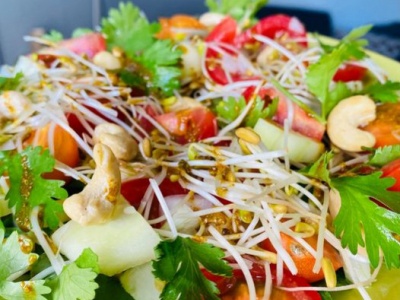
Quick Indian Salad — cherry tomato, cucumber, red onion, fresh coriander, fenugreek sprouts, lemon, rapeseed oil. A complete dish in 5 minutes.
Digestive Infusion — 1 teaspoon of crushed sprouts infused for 5 minutes in 200 mL of simmering water, to drink after a heavy meal.
Which Seeds to Choose and Where to Buy Organic Fenugreek for Sprouting?
Not all fenugreek seeds are equal: for sprouting, choose certified organic and edible seeds (not seed-grade — horticultural batches may be treated with fungicides). The stated germination rate should be at least 95%.
The organic fenugreek sprouting seeds offered by Biovie are selected from tested batches and available in 300 g and 5 kg formats, with a guaranteed germination rate.
“Sprouted seeds have a good yield, and the Easygreen sprouter makes germination a real breeze.” — Meriem Lilya, Biovie customer (Google review ⭐⭐⭐⭐⭐)
Fenugreek is a safe plant for most healthy adults, but certain situations require caution. Here are the key points from the opinions of ANSES (opinion 2025-SA-0064), the European Medicines Agency (EMA), and the NCCIH (NIH):
Pregnancy: use not recommended. Cases of fetal malformations associated with fenugreek intake by the mother have been documented.
Breastfeeding: data remains insufficient despite traditional "galactagogue" use — ANSES and EMA recommend abstention.
Diabetes under treatment: additive hypoglycemic effect with antidiabetics (metformin, sulfonylureas, insulin). Essential blood sugar monitoring and prior medical advice.
Anticoagulant treatment (such as warfarin): blood-thinning effect of fenugreek — combination to be avoided.
Allergies: possible cross-reactions with peanuts and chickpeas. Rare but real anaphylactic risk.
Children under 5 years and immunocompromised individuals: prefer cooked consumption to limit microbiological risk associated with sprouted seeds (recall: E. coli O104:H4 outbreak in 2011 in Germany, linked to contaminated sprouts during production).
Body odor: sotolone, the molecule responsible for the "curry-maple" aroma, passes into sweat, urine, and breast milk. It's harmless but can be surprising.
Germination hygiene: rinse twice a day, store in the cold after harvest, consume within 3 to 5 days. If in doubt (smell, appearance), discard without hesitation.
Frequently Asked Questions About Sprouted Fenugreek
What are the benefits of sprouted fenugreek seeds?
Sprouted fenugreek seeds offer pre-digestion of proteins, an increase in antioxidants (+56 to 76%), a clinically documented hypoglycemic effect (−14 to −23 mg/dL fasting blood sugar), improved lipid profile, increased mineral bioavailability (calcium, magnesium, iron), and support for digestive comfort thanks to galactomannan.
How to sprout fenugreek seeds?
Soak 2 tablespoons of organic seeds for 12 hours, then rinse and drain morning and evening for 3 days at room temperature (18-22 °C) and in dim light. The sprouts are ready from day 4, when they measure 0.5 to 2 cm.
What are the disadvantages of fenugreek?
Fenugreek is not recommended during pregnancy and breastfeeding, interacts with antidiabetics and anticoagulants, can cause allergic reactions (especially in people allergic to peanuts), and gives a characteristic "curry-maple" odor to sweat and urine.
Is it acceptable to consume sprouted fenugreek every day?
Yes, apart from the above contraindications, 1 to 2 tablespoons per day of sprouted fenugreek can be perfectly integrated into a varied diet. If you are diabetic or under treatment, seek medical advice before making it a daily consumption.
Why does fenugreek cause a bad smell?
Fenugreek contains sotolone, a molecule with a strong odor reminiscent of maple syrup and curry. It is excreted in sweat, urine, and breast milk. The odor is harmless and disappears within 24 to 48 hours after stopping consumption.
How long do fenugreek sprouts last?
Once harvested and well-drained, fenugreek sprouts can be kept for 3 to 5 days in the refrigerator, in a ventilated container. If they have a sour smell or a slimy appearance, discard them without hesitation.
Sprouted fenugreek and libido: what does science say?
The steroidal saponins and phytoestrogens in fenugreek are studied for their effects on male sexual desire and performance. The results are promising in healthy adult men, but the doses used in clinical studies are higher than the usual amounts of dietary sprouts. See our dedicated article fenugreek for men.
"Fenugreek has accompanied 33 years of my vegan life. I recommend it to anyone starting sprouting: it is quick, robust, and its unique aromatic signature encourages recipe invention. Beyond the gustatory curiosity, it is mainly its protein profile and hypoglycemic effect that make it a valuable ally — provided ANSES precautions are respected, especially during pregnancy." — Eric Viard, founder of Biovie.
Disclaimer: The information presented in this article is provided for informational purposes and does not constitute medical advice. Consult a qualified healthcare professional before making any significant changes to your diet or supplementation. As part of a varied and balanced diet and a healthy lifestyle.