Fast delivery
.png)
 Fair prices




Thewhite clay For babies — kaolinite, to be precise — is one of the gentlest and most reliable natural care products that can be used on infants' sensitive skin. Its simple mineral composition (silica and alumina, neutral pH), traceable origin from the Gard region, and the total absence of chemicals make it a serious alternative to industrial talc. As an agronomist engineer and co-founder of Biovie since 2007, I have seen hundreds of parents discover this French sedimentary rock with some surprise — and adopt it permanently. Here is everything you need to know to use it safely on your baby's or infant's delicate skin.
How to use white clay for babies ?
Its use for babies is a natural way to care for diaper rash. — this redness of the skin that can be caused by prolonged congestion in the layer. To treat irritations, there are two methods depending on the intensity of the situation.
White clay as a natural alternative to talc
If your baby's bottom is simply red, use white clay powder just like talcum powder: sprinkle directly on the bottom at each diaper change. Apply a small amount to help absorb urine and feces until the next change. The absorbent and purifying properties of kaolinite white clay help maintain a healthy environment in the baby's diaper. This biomineral helps protect the baby's delicate skin in a gentle and natural way.
Caution: do not apply too much. A layer of powder that is too thick could dry out your baby's delicate skin — a light dusting is more than enough. According to the work of Gupta and Versteeg (Journal of the American Academy of DermatologyKaolin clays have documented adsorbent properties, useful for irritative dermatitis such as diaper rash (recognized traditional use).
For more pronounced irritations, prepare a poultice: mix about 3 tablespoons of water with 1 tablespoon of fine powdered clay. Apply a thick layer (5 to 10 mm) directly on the irritated areas, then put the diaper back on as usual. The moist environment of the diaper will slow down the drying of the poultice — this is important because if the clay dries too quickly, it may pull on the baby's skin and cause itching. The same technique of clay poultice is also very effective for sunburns in older children.
White clay is particularly effective in helping to relieve irritations on your baby's neck, armpits, and thigh folds. For these areas, simply sprinkle white clay powder as you would with talcum powder. It can also be used as a thin poultice for natural minor ailments, the areas irritated by eczema or small superficial wounds — apply, let it sit for about 20 minutes, then rinse with clear water. In concrete terms, baby white clay is this: versatile, economical, and unsurprising.
A supplement that I gladly use at home: the baby liniment, combined with white clay, forms a very comprehensive natural care duo for daily diaper changing.
What are the benefits of white clay for babies ?
White clay is a natural product ideal for caring for the delicate skin of babies. Kaolinite — its exact mineralogical name — is officially listed as a cosmetic excipient and skin protective agent in the European Pharmacopoeia (Ph. Eur.), with established dermatological tolerance on sensitive skin. Its composition of silica (SiO₂) and alumina (Al₂O₃), documented by Murray (Applied Clay Mineralogy, Elsevier, 2007), gives it a neutral pH compatible with the immature epidermis of newborns. The richness in silica plays a role in naturally supporting skin regeneration.
It possesses purifying and protective properties that help regulate the functions of the epidermis, while being gentle and well-tolerated by baby skin. Its neutral pH makes it suitable even for the most reactive skin. Specifically, it is:
- Non-allergenic
- Sanitizing
- Favorable to natural healing
- Absorbent
- Purifying (captures skin impurities)
- Revitalizing
- Soothing
Its absorbent and soothing properties make it an interesting natural ally against redness and irritations on babies' skin. It helps to relieve redness and discomfort while supporting the skin's natural processes by providing mineral salts and trace elements. It captures skin impurities and cleanses the baby's bottom. It is a natural solution for sensitive or irritated skin of infants.
White clay is also a very economical product: for less than one euro per week, you have a complete natural skincare solution for your baby's skin, without the chemicals found in industrial creams. By using this biomineral appropriately, you avoid resorting to creams containing potentially irritating substances for infants' sensitive skin. There you go, it's as simple as that.
If you are pregnant or have just given birth, our article on the Benefits of clay during pregnancy will interest you — kaolinite also accompanies mothers at key moments.
What type of clay to use for a baby ?
Superfine white clay is a natural treatment suitable for the delicate skin of babies. However, there are different types of clay, such as green clay, which is also an excellent choice for skincare. Here's how to navigate them.
White clay or green clay for baby ?
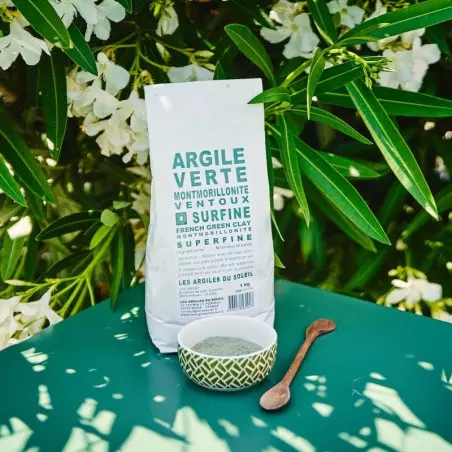
White clay is the gentlest of all available clays — this is why it is primarily recommended for newborns and very sensitive skin. Its action is delicate, with a neutral pH. Thegreen clay It possesses soothing, absorbent, and healing properties that can help reduce a baby's red bottom quite quickly — it's a high-quality complementary option, but its action is more powerful. For babies under 3 months or particularly sensitive skin: superfine white clay, without hesitation.
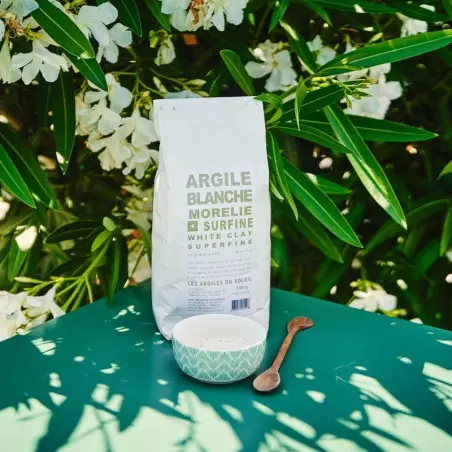
It is recommended to choose high-quality clays, such as superfine white kaolinite morélie — known for its impeccable composition, sourced from our supplier in Gard, near Avignon, with complete traceability. White clay and green clay are effective and proven natural products for taking care of babies' skin, while avoiding the use of harmful chemicals for the body. To learn more about this topic, consult our guide for choose a clay based on your skin type.
White clay for baby bath
Less known, this use is nonetheless worth mentioning. One to two tablespoons of white clay diluted in the baby's bath water — well mixed — create a slightly milky, very soft water. Contact with this slightly mineralized water by kaolinite can help soothe irritated skin and leave a natural protective film on the epidermis. Rinse the baby well after the bath. This use is reserved for babies without open wounds — if in doubt, consult your pediatrician beforehand.
Is white clay a danger for babies ?
White clay is a natural product that is well-tolerated for caring for a baby's delicate skin. It has multiple properties that make it an effective and reliable care product. However, it is important to follow certain usage precautions to ensure the effectiveness and safety of this kaolinite for your baby.
Never handle white clay with metal utensils: this can alter its mineral properties. Prefer wood, ceramic, or glass for handling. Plastic should also be avoided — it becomes charged with static electricity. If you use it as a poultice on the face or body of a baby, do not let it dry and crack on the skin: slightly moisten it before rinsing with clear water if necessary.
Keep the white clay dry and away from light to maintain its properties — a paper bag, cardboard packaging, or glass jar are perfectly suitable. And consult a healthcare professional if in doubt.
White clay and reflux (GERD) in babies
An important point, because the question comes up regularly: White clay for babies is strictly reserved for external use. It must absolutely not be ingested by infants — do not confuse it with certain drinking clays intended for adults, which follow very different protocols.
If your baby suffers from gastroesophageal reflux (GER), consulting your pediatrician is essential—it's a medical issue. However, white clay can help soothe skin irritations around the mouth caused by acidic regurgitations: a gentle poultice, applied locally to the reddened areas, can help soothe the skin around the mouth and chin. In case of an open wound or suspected superinfection, also consult a healthcare professional before applying any clay.
Here, this list is of course not exhaustive — but it covers the essential questions that parents have. White clay for babies is a simple, natural, and remarkably versatile care product. To try it is to adopt it.
FAQ — White Clay for Babies: Your Frequently Asked Questions
How to use white clay for babies ?
For mild redness, sprinkle white clay powder on the baby's bottom at each diaper change, as a replacement for talcum powder. For more pronounced irritations (marked diaper rash), prepare a poultice by mixing 1 tablespoon of white clay with 3 tablespoons of water. Apply a layer of 5 to 10 mm on the irritated areas and put the diaper back on as usual. On other areas of the body (neck, folds), rinse with clear water after about 20 minutes.
Is white clay a good alternative to baby talcum powder ?
Yes, white kaolinite clay is an excellent natural alternative to talc. It absorbs moisture, cleanses the delicate skin of babies, and contains no irritating chemicals. Unlike industrial talc, it is composed of 100% natural minerals with a neutral pH, non-allergenic. Listed in the European Pharmacopoeia, its dermatological tolerance on sensitive skin is documented. Use it at each diaper change, in small quantities.
Which clay to choose for baby: white or green ?
White clay (kaolinite) is recommended primarily for babies, as it is the gentlest of all clays. Green clay can also be suitable due to its healing and absorbent properties, but its action is more potent. For newborns and very sensitive skin, opt for superfine white clay. In any case, choose a quality clay with a traceable origin and a very fine particle size (superfine).
Is white clay effective against diaper rash ?
White kaolinite clay is known for its absorbent, purifying, and natural healing properties that help relieve diaper rash. Applied as a dry powder at each diaper change or as a wet poultice on irritated areas, it helps maintain a healthy environment in the diaper and reduce redness. For persistent rash or superinfection, consult your pediatrician.
Can white clay be used for reflux (GERD) in babies ?
White clay for babies is strictly reserved for external use (skin). It should not be ingested by infants. If your baby suffers from gastroesophageal reflux (GER), consult your pediatrician. However, white clay can help soothe skin irritations around the mouth related to acid regurgitation, when applied locally as a gentle poultice on the reddened areas.
References
- European Pharmacopoeia (Ph. Eur.) — Kaolin monograph. EDQM, 11th Edition. (Kaolin officially recognized as a cosmetic excipient and skin protective agent, dermatological tolerance established on sensitive skin.)
- Gupta AK, Versteeg SG. "Traditional uses of clays in dermatology." Journal of the American Academy of Dermatology. (Documented adsorbent properties of kaolin for irritative dermatitis, including diaper rash — recognized traditional use.)
- Murray HH. Applied Clay Mineralogy: Occurrences, Processing and Application of Kaolins, Bentonites, Palygorskite-Sepiolite, and Common Clays. Elsevier, 2007. (Mineralogical composition of kaolinite — silica and alumina, neutral pH, compatibility with sensitive skin.)
- Base CosIng — INCI sheet of kaolinite. European Commission. (Official listing of kaolinite as a cosmetic ingredient — functions and regulatory restrictions.)
Update: March 2026. Article approved by Éric Viard, founder of Biovie and engineer ISTOM, co-author of " Seaweed in everyday life "(Gallimard, 2024) —" Best cookbook in the world, Gourmand Cookbook Awards 2025, and Best cookbook in France, National Academy of Cuisine 2025.
To go further: our guide for well prepare for a natural pregnancy and our Complete guide to baby food diversification.
Warning: The information presented in this article is provided for informational purposes only and does not constitute medical advice. White clay is for external use only — never ingest it or give it to a baby or infant. Consult your pediatrician or a qualified healthcare professional if you have any concerns about your child's skin condition or before making any changes to your care practices.