

A button that stings, a sunburn that pulls, an insect bite that itches, a small burn from a pan, a walking blister... The everyday minor ailments recur repeatedly in all families. In response, the green pharmacy is full of solutions, but most traditional clay poultices share the same flaw: they dry out in two hours and must be constantly renewed.
The clay wax — also called Clay wax or Drawing salve in Anglo-Saxon traditions — solves this problem with elegance. By combining green clay, beeswax, and olive oil, you get a homemade healing ointment that lasts up to 24 hours on the skin, without drying out or slipping.
In this guide by Éric Viard, you will find the original recipe by Belgian naturopath Theophiel Van Dyck with precise measurements, the complete instructions according to the type of ailment, the scientific basis supporting its use, and the essential precautions to know before the first application.
What is clay wax?
Clay wax is a homemade natural healing ointment which combines three ingredients: powdered green montmorillonite clay, organic beeswax, and extra virgin olive oil. Once set in a jar, it forms a solid paste at room temperature that melts upon contact with the skin, leaving an active film for several hours.
Unlike a clay poultice classic — a mixture of clay and water applied between two compresses — the clay wax remains stable, does not stain, does not run, and retains its absorbent properties over time. It is similar in its logic to the Drawing salve Anglo-Saxon, these traditional ointments are designed to "draw out" impurities and aid in superficial healing.
The recipe we use here is that of Theophiel Van Dyck, a renowned Belgian naturopath who documented the formulation at the beginning of the 20th century. His very precise ratio — 28% clay, 14% wax, 58% oil — is still widely used today by enthusiasts of self-sufficiency in natural care.
The 3 ingredients of the recipe
1. Unheated Montmorillonite green clay
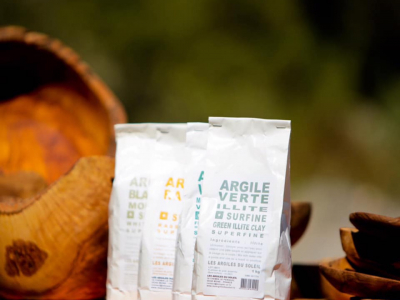
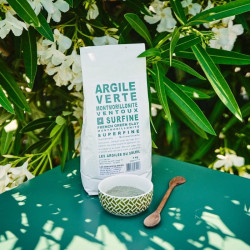
Montmorillonite green clay is the centerpiece of the ointment. Originating from the Mont Ventoux massif (Vaucluse), it is extracted and then sun-dried, without thermal treatment, to preserve its ion exchange capacity and its adsorbent properties. It is this clay that, according to scientific literature, captures impurities, absorbs excess sebum, and neutralizes certain bacteria upon contact with the skin.
The choice of clay unheated is crucial: industrial cooking denatures its crystalline structure and depletes its adsorption capacities. This is why Biovie has chosen to reference for twenty years a clay dried exclusively in the sun, a rarity on the French market.
To learn more, read our complete guide on green clay for the skin.
"The only site offering unheated clay."
— Seb Beau, Trustpilot review 5/5
2. Organic beeswax
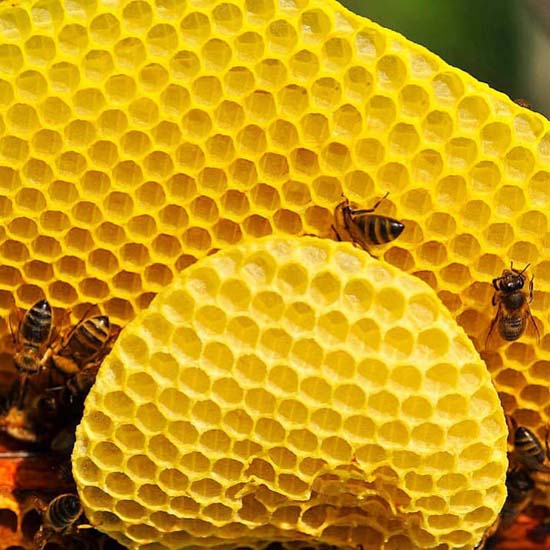
Beeswax (produced by the wax glands of worker bees) plays two roles in the recipe: it Emulsify the clay-oil mixture to obtain a homogeneous paste, and it forms when drying a occlusive barrier which keeps the ointment in place for several hours. Its melting point is between 62°C and 65°C, allowing it to melt gently in a water bath without degrading the other ingredients.
Favor a beeswax yellow, organic, and unbleached, ideally of French origin. An industrially bleached wax has lost most of the traces of propolis and pollen that give it its slight antibacterial properties.
3. Extra virgin olive oil first cold pressed
Extra virgin olive oil is the lipid vector of the recipe. Rich in oleic acid (omega-9), tocopherols (vitamin E), and polyphenols, it nourishes the skin, limits dryness, and contributes, according to the literature, to superficial skin repair. Be sure to choose an oil First cold pressing, unfiltered if possible., to preserve the active compounds.
The step-by-step recipe (for 311 g)
The Van Dyck ratio is expressed in precise measurements, to be strictly followed in order to achieve the right texture:
- 87 g non-heated green montmorillonite clay (28%)
- 43 g organic beeswax in flakes or pellets (14%)
- 181 g extra virgin olive oil first pressing (58%)
Be a total of 311 grams ointment, enough to fill six 50 ml tinted glass jars.
Necessary equipment : a stainless steel or heat-resistant glass bowl, a saucepan for the double boiler, a wooden or silicone spatula, a precision scale (accurate to the gram), six 50 ml tinted glass jars with lids (ideally amber or cobalt blue to protect from light).
Preparation steps:
- Weigh the ingredients separately in three clean and dry containers.
- Place the beeswax and olive oil in the bowl, using a double boiler. Heat gently until the wax is completely melted (about 65°C), stirring regularly.
- Remove from the bain-marie. Let cool for 2 to 3 minutes (target temperature: 55-60 °C).
- Incorporate the clay into light rain, stirring constantly with a spatula to avoid lumps. The mixture should become smooth and slightly creamy.
- Pour immediately into glass jars. Let set at room temperature for 2 hours, uncovered, until completely solidified.
Conservation: 12 to 18 months away from light and heat (ideally in a cupboard at less than 20°C). Label each jar with the manufacturing date.
Instructions: How to Apply Clay Wax?
The instructions vary depending on the type of injury. In all cases, always apply to clean and dry skin.
Bump, insect bite, or local irritation
Take a hazelnut With a clean fingertip, apply a thin layer of ointment directly to the area, massage for 10 to 20 seconds. Leave on for 2 to 4 hours, then rinse with lukewarm water. Repeat morning and evening.
Mild burn, sunburn, or superficial wound
Apply a thick layer of ointment (2 to 3 mm) on a sterile gauze pad, apply ointment to the area, secure with a non-tight bandage. Leave in place for up to 24 hours, then renew if necessary. It is in this use that clay wax reveals all its benefits: the dressing remains active without drying out for an entire day.
For extensive sunburns, Also check out our article on clay poultices for sunburns., which details a more liquid complementary approach.
Fungal infection, corn, joint or muscle pain
Apply locally in the morning and evening for 7 to 10 days, without rinsing (allow the skin to absorb). For fungal infections, discover our other complementary natural remedies..
Maximum continuous application duration: 24 hours per application. Beyond that, remove the ointment, clean the area with warm water, and reapply after a few hours of rest.
Why it works: what science says
The use of green clay in skincare is not merely a folkloric tradition. Scientific literature documents several mechanisms that make clay active on the skin.
A review published in the journal Applied Clay Science (Svensson & Thelin, 2011) synthesizes more than fifty studies showing that smectite clays (of which montmorillonite is a part) contribute to theAdsorption of exudates, stimulate local microcirculation and can contribute to the healing process of superficial wounds. In 2014, Morrison and his collaborators demonstrated in vitro the antibacterial activity of natural iron-rich clays against pathogenic strains such as E. coli and Staphylococcus aureus, with mechanisms related to the controlled release of metal ions.
The beeswax, on the other hand, is recognized by the European Pharmacopoeia as an emollient and occlusive excipient. A review by Fratter and colleagues (2020, Cosmetics) recalls its role as a protective barrier and its minor antibacterial properties related to the presence of residual propolis in unrefined waxes.
As for theextra virgin olive oil, Several studies (Viola & Viola, 2009; more recently Aparicio-Soto et al., 2016) describe its benefits in skin repair through its anti-inflammatory polyphenols and emollient oleic acid.
These three combined ingredients therefore offer a synergy. contributing to superficial healing, provided they are used on minor lesions and in accordance with the precautionary rules below.
"Thank you for the quality of the Montmorillonite green clay at a very reasonable price."
— Yveline-Justine, Google review 5/5
Precautions and contraindications
Clay wax is reserved for theexternal use only. Do not ingest this product, which contains olive oil and beeswax that are inedible in large quantities mixed with clay formulated for cosmetic use.
The following situations require a prior medical advice :
- Deep wounds, sutured wounds, second or third-degree burns (white area, extensive blister, very intense pain): immediate medical attention is required, clay wax is not recommended.
- Uncontrolled diabetes, neuropathy, or known healing disorders: seek advice before any application.
- Known allergy to beeswax or pollen: test the ointment on the elbow crease for 24 hours before use.
- Pregnancy: The external use of basic clay wax (3 ingredients without essential oils) is generally compatible, but avoid versions enriched with essential oils during the first trimester.
- Children under 3 years old: use only the basic version (without essential oils), apply in thin layers, and avoid areas near the eyes and mouth.
Reminder: The National Agency for the Safety of Medicines (ANSM) issued strict recommendations in 2019 regarding theingestion of certain clays (notably kaolin) due to the risk of lead contamination. These recommendations do not concern external use, but they remind that clay — even of excellent quality — should remain confined to topical application within the context of this ointment.
Vegan variants and alternatives
Vegan version without beeswax
For a 100% plant-based clay wax, replace the beeswax with candelilla wax (-30% in quantity, or approximately 30 g instead of 43 g) or by the carnauba wax (-20%, or approximately 34g). Slightly adjust the olive oil to compensate for the difference in texture.
Enriched version with essential oils
For targeted action, incorporate 10 to 15 drops essential oil into the still warm mixture, just before pouring into jars:
- Lavender spike for burns and stings (contraindicated for children under 6 years old and during the first trimester of pregnancy)
- Tea tree for fungal infections and pimples (avoid in children under 6 years old)
- Roman chamomile for irritations and dry eczema
Before choosing an essential oil, consult our guide on essential oils for the skin..
Express version without wax (children and beginners)
For a quick preparation, simply mix 2 tablespoons of green montmorillonite clay with 3 tablespoons of olive oil. The hold is reduced to 4-6 hours, but the texture is ideal for the little ones and for people allergic to beeswax.
FAQ: Homemade Clay Wax
Is clay wax the same thing as a clay poultice?
No. A classic poultice is a mixture of clay and water applied fresh between two compresses, which dries in two hours. Clay wax adds beeswax and olive oil, making it solid, stable, and directly applicable to the skin. It lasts up to 24 hours without drying out, whereas the poultice needs to be renewed frequently.
How long can homemade clay wax be stored?
Between 12 and 18 months away from light and heat, in a hermetically sealed tinted glass jar. Always label each jar with the manufacturing date. If the smell changes, the color turns, or mold appears, discard the jar without hesitation.
Can clay wax be used on the face and acne?
Yes, apply it directly on an isolated spot in a thin layer, leave it for 2 to 4 hours, then rinse with lukewarm water. Avoid applying the ointment in a thick layer over the entire face: beeswax is occlusive and could promote comedones on very oily skin. For acne-prone skin, opt for the express version without wax.
Does clay wax work on old scars?
Its action is documented on ongoing superficial healing, not on old and stabilized scars. For the latter, other approaches (massages, specific oils, dermatological treatments) are generally more suitable. However, clay wax remains interesting for maintaining skin suppleness around a recent scar.
Can I use a different clay than montmorillonite (kaolin, illite, ghassoul)?
Technically yes, but the properties will be different. Montmorillonite (green clay) is the most adsorbent. Kaolin (white clay) is gentler, suitable for sensitive skin. Illite (green illite clay) is similar to montmorillonite. Ghassoul is more soapy and less relevant in this recipe. For the original Van Dyck recipe, unheated montmorillonite remains the preferred choice.
Does clay wax stain clothes?
Yes, it can leave green stains on light-colored fabrics. We recommend protecting your clothing during the application time (old t-shirt, towel) and keeping a compress if the application is prolonged. The stains can be removed with a regular wash at 30°C with prior stain removal using Marseille soap.
About the author
"Clay wax is a lesson in autonomy that we received from naturopaths of the last century. Three ingredients, a scale, a double boiler, and you're equipped for all the little ailments of the family, without rushing to the pharmacy. It's this spirit of transmission and sovereignty over one's health that has always been close to my heart at Biovie."
Éric Viard — Tropical agronomist engineer, co-founder of Biovie.fr Since 2007, 33 years of veganism, co-author with Aurélie of the book Seaweed in Everyday Life (Gourmand World Cookbook Award + National Academy of Cuisine Prize).
Update: April 2026.
Warning: This article is provided for informational purposes only. Clay wax is a supplementary treatment for minor superficial injuries. It does not replace medical advice in any way. Consult a healthcare professional for any deep wound, extensive burn, infection, or healing disorder.
Discover the unheated Montmorillonite clay from Mt Ventoux at the Biovie store..