Olive wood utensils: advantages, maintenance, and durability
The olive wood kitchen utensils are increasingly attracting chefs and enthusiasts of raw cuisine. Why? Because they combine three rare qualities: a unique beauty (dense grain, natural veins), a remarkable resistance (density 900-950 kg/m³, nearly double that of beech) and of the natural antimicrobial properties today documented by science.
At Biovie, we have been using these utensils daily for nearly 20 years. Therefore, we know what makes an olive wood board last 25 or 30 years... and what can destroy it in just a few months. This comprehensive 2026 guide gathers everything you need to know about themaintenance of olive wood : the real benefits, the types of utensils to prioritize, the proper washing techniques, the frequency of oiling, the repairs to master, and the mistakes to absolutely avoid.
Whether you've just bought your first set or are looking to save a damaged board, you will find concrete answers here-backed by verifiable scientific sources.
The advantages of olive wood utensils
Olive wood utensils are highly valued for their multiple qualities. They not only add an elegant touch to your kitchen but also offer various functional benefits that are well-documented. Let's take a closer look at the aesthetic advantages, antibacterial properties, the protection they provide to pan coatings - and why this Mediterranean wood deserves a place in every kitchen concerned with sustainability.
Natural and elegant aesthetics
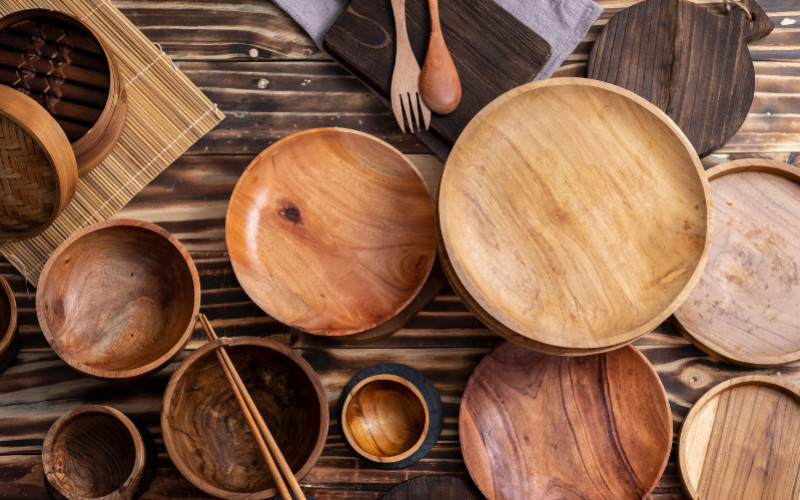
Olive wood is distinguished by its unique grain and its elegant natural patterns. Each piece is unique: no board or spoon has exactly the same grain, the same amber/brown contrasts, or the same visual signature. These characteristics make olive wood utensils objects that enhance a kitchen over time. They bring a rustic Mediterranean charm, an authentic feel - and a patina that deepens with years of use.
Antibacterial and hypoallergenic properties
One of the great qualities of olive wood utensils is their natural antibacterial property. Olive wood is less porous that most other kitchen woods, which allows it to resist humidity and the development of bacteria. Moreover, it is hypoallergenic, making it safe for daily use in contact with food.
These qualities are not just simple marketing arguments. They are based on several scientific studies. The famous study by Professor Dean Cliver at UC Davis University (1993, Journal of Food Protection) showed that 99.9% of the bacteria placed on a wooden board (Salmonella, Listeria, E. coli) died within three minutes., without any chemical intervention - while these same bacteria survived and proliferated on plastic (sourceA study from Kansas State University (1994) confirmed this mechanism: wood absorbs bacteria which eventually die from dehydration, whereas plastic retains them on the surface.
More specifically for the olive tree, a systematic review published in 2021Molecules, PMC8399450) documented the antimicrobial activity of polyphenols extracted from the olive tree (oleuropein, hydroxytyrosol, ligstroside) in vitro against Staphylococcus aureus, , Escherichia coli and Candida albicans. These compounds contribute to the natural defense of wood against microorganisms.
Protection of pan coatings
Olive wood items are soft for cooking surfaces, unlike metal utensils that can scratch and damage non-stick coatings. Their natural texture helps protect your pans and pots, thus extending their lifespan. This makes them an ideal choice for all your culinary needs while preserving your kitchen accessories.
Why olive wood rather than another type of wood ?
Faced with beech, bamboo, or acacia, olive wood has very concrete advantages. Its exceptional density (900-950 kg/m³) makes it one of the densest kitchen woods - compared to 720 kg/m³ for beech or 600-800 kg/m³ for a composite bamboo board. This density means: less porosity, less water absorption, less risk of cracking, better resistance to cuts, and a longer lifespan.
Faced with the bamboo, often marketed as eco-friendly, olive wood offers another advantage: it is a true solid hardwood, whereas the majority of bamboo boards are compressed fibers glued with resins - some of these glues can release formaldehyde. In the face of beech, softer, olive wood is less marked by the knife and better accepts renovations through sanding. Faced with theacacia, its grain is finer and its pattern more decorative.
Types of olive wood utensils to consider
Olive wood utensils and accessories are not only elegant but also durable. This type of wood is known for its Robustness and its beautiful natural veins. Whether you are a professional chef or a cooking enthusiast, olive wood utensils can add a Mediterranean touch to your kitchen while remaining functional and easy to maintain.
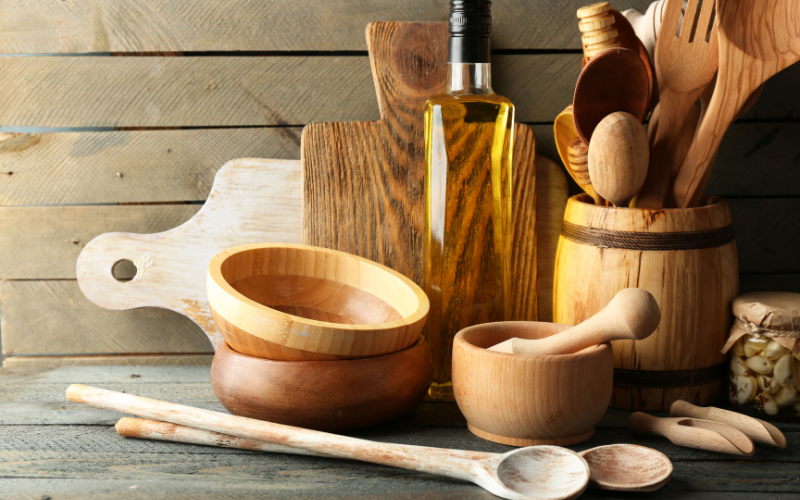
Cutting boards
The cutting boards Olive wood is highly valued for its resistance to cuts and its natural antibacterial surface, which reduces the risk of cross-contamination. They are ideal for cutting vegetables, fruits, bread, but also for arranging cold cuts or cheeses for appetizers. To take care of them, avoid immersing them in water. Clean them with mild soap and a damp cloth, then regularly apply a layer of suitable food-grade oil to preserve their shine and waterproofing.
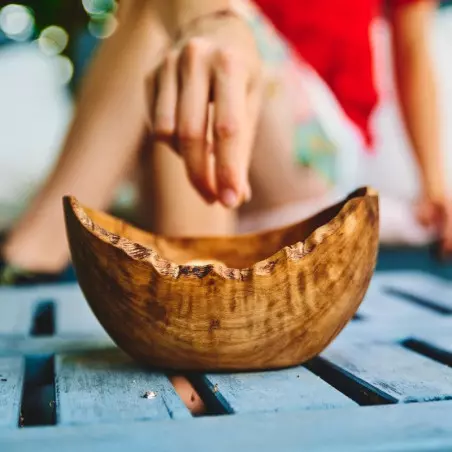
Olive wood bowl
A olive wood bowl can be used for many purposes, from serving appetizers to vibrant salads or fruit bowls. Its smooth and natural finish prevents food odors from sticking permanently. Be sure to wash it by hand with a mild dish soap and dry it immediately with a soft cloth to avoid water stains.
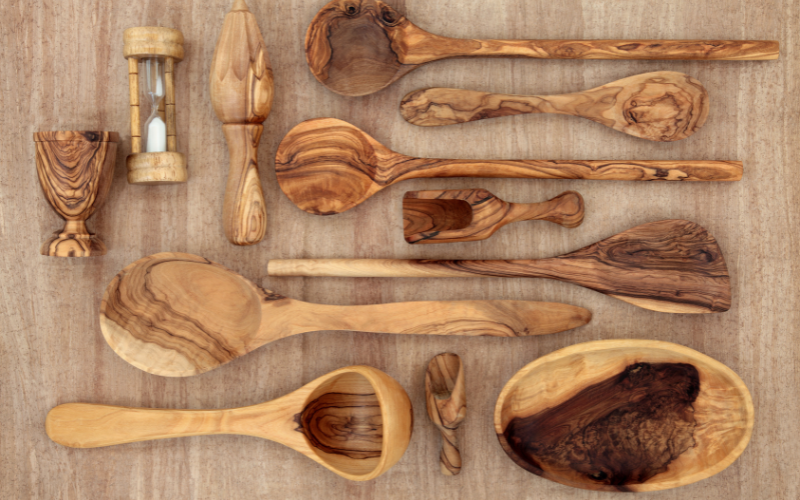
The spoons and spatulas Olive wood utensils are the daily ally for all cooking: they do not scratch coatings, do not conduct heat (you won't burn your fingers), and perfectly withstand prolonged contact with hot preparations. Their polished handle is pleasant to hold. To maintain them, follow the same rules: hand wash, immediate drying, occasional oiling.
A olive wood mortar is perfect for grinding spices, herbs, or seeds-without the essential oils released being permanently absorbed into the material. Repeated use gives the wood a patina that enhances the flavor of subsequent preparations. Same maintenance: no standing water, careful drying, occasional oiling.
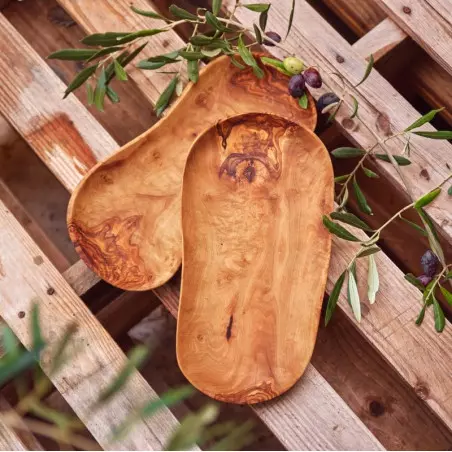
Salad bowls and large plates
The Salad bowls and large plates Olive wood pieces are centerpieces for serving at the table. For a salad bowl of raw vegetables, the natural surface releases a light fragrance that enhances the tasting experience. For presentation, applying oil before serving highlights the wood's grain.
The complete set: why invest in a matching series ?
Buy a complete set of olive wood utensils presents two concrete advantages. First, theaesthetic homogeneity : the pieces come from the same batch, share the same patina, and create a visually coherent collection in the kitchen. Then theLong-term economy : a set purchased at once costs significantly less than the sum of the individual pieces, and all the utensils will age together under the same maintenance.
How to wash your olive wood utensils ?
Washing is the decisive step. A wrong move can crack an olive wood in one go. The right actions, on the other hand, preserve it for decades.
Hand wash only
Wash your utensils In lukewarm water, never boiling (thermal shock can crack the wood). Use a soft sponge or cloth and a neutral, gentle dishwashing liquid, ideally with a neutral pH. Absolutely avoid abrasive sponges and metal brushes that scratch the surface and leave grooves where residues accumulate.
The absolute prohibitions
Three actions ruin an olive wood utensil:
The dishwasher : hot steam + harsh detergents + prolonged drying = guaranteed cracks in just a few cycles.
The microwave and the oven : olive wood is not designed for cooking or heating.
Prolonged immersion : leaving a board to soak in the sink = water absorption, warping, cracks.
Immediate drying
After washing, wipe immediately your utensils with a clean and dry cloth. Do not let them air dry on a damp surface. Store them in a dry and airy place, away from moisture and direct sunlight.
Tips for stubborn stains and persistent odors
If your board or bowl retains a smell of garlic, fish, or onion: rub with a mixture of baking soda and lemon juice, let it sit for 2-3 minutes, rinse with lukewarm water, dry. For a more stubborn stain: half a lemon sprinkled with coarse salt, gentle rubbing, rinsing.
Oiling: The Secret to Olive Wood Lasting 30 Years
Regular oiling is the most important maintenance gesture. Untreated wood dries out, becomes dull, and cracks - in 2 years, it might be ready for the trash. Well-oiled wood lasts 25 to 30 years, or even longer. Never neglect this step.
Which oil to choose ?
Not all oils are suitable for wood. Three recommended options:
Food-grade mineral oil (Food-grade paraffin / food-grade vaseline oil): neutral, odorless, does not become rancid. The safest and most durable option.
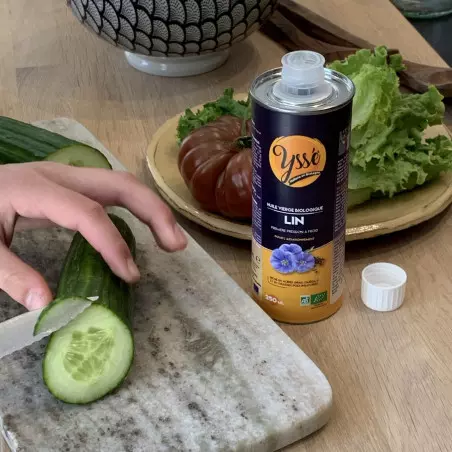
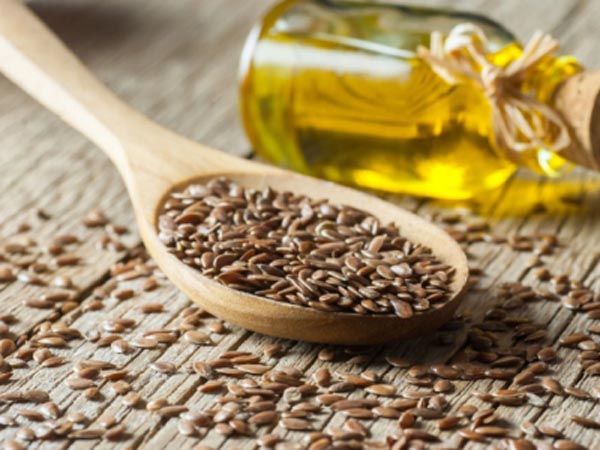
Linseed oil polymerized (fired at high temperature): penetrates well, polymerizes on the surface to form a protective barrier. Caution: Virgin linseed oil (raw food-grade) is not suitable for oiling boards that are in regular contact with food. - it turns rancid and can impart a taste. It remains excellent in nutrition.Benefits of flaxseed oil) but not for this use.
Food-grade beeswax (often mixed with mineral oil): excellent for finishing and protecting, gives a satin finish.
Olive oil is strongly discouraged. to oil wooden utensils: it becomes rancid and imparts a persistent unpleasant odor over the weeks.
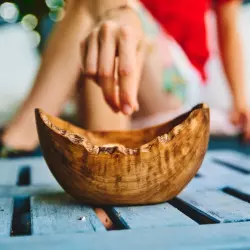
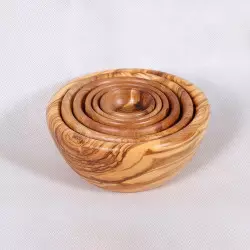
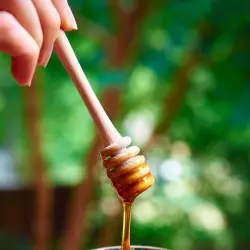
Biovie offers handcrafted olive wood bowls and spoons: a set of 6 bowls, an irregular one-of-a-kind bowl, a honey spoon and a wooden measuring spoon. Each piece is unique, as the wood grain varies from one object to another., 4
products
A tarnished, scratched, or stained olive wood is (almost) never lost. In most cases, a simple renovation brings it back to new in less than an hour. Here are the four most common situations.
Fine sanding to remove scratches and cuts
For a board scratched by knives or dulled by use, use some 220 grit sandpaper in the first pass, then refine with a grit 400 for a smooth touch. Always sand in the direction of the grain, never across. Carefully wipe off the dust dry, then immediately apply a coat of mineral oil to nourish the "freshly opened" wood.
Treating a grease or rust stain
For a set-in grease stain: paste of baking soda + water, let it sit for 10 minutes, gentle rubbing, rinsing, drying, oiling. For a rust stain (contact with a pan): pad soaked in diluted white vinegar (50/50), rubbing, quick rinse, drying, oiling.
Reviving a dull wood
For tarnished wood that has lost its shine: prepare a homemade mixture of 2/3 mineral oil + 1/3 food-grade beeswax Melt in a double boiler. Apply warm (not hot) in a generous layer, leave for 2 hours, and polish with a soft cloth. The wood regains its depth and a very resistant satin patina.
When to replace an olive wood utensil ?
Despite all this love, sometimes you have to resign yourself to replacing. The non-negotiable signs:
Deep through cracks : they create bacteria traps that are impossible to sanitize.
Wood that crumbles, which loses shavings under the knife.
Persistent odor despite baking soda + lemon + oiling.
Visible mold in the form of deep blackheads.
Mistakes to avoid to preserve your utensils
Summary of the most common mistakes to absolutely avoid:
Dishwasher : destroys the structure of the wood in a few cycles.
Prolonged soaking in the sink: swelling, deformation, cracks.
Olive oil or virgin linseed oil for oiling: rancidity, bad taste.
Abrasive sponges and wire brushes : deep scratches.
Standing drying on a wet surface : water absorption by the edge.
Storage in a damp place (near the sink, in a poorly ventilated cupboard): mold.
Forget to oil for 6 months : gradual drying followed by cracks.
Olive wood and food safety: what science says
The antibacterial argument for wood has long been contested by the plastic industry, until several studies came to confirm it. Three references are now considered authoritative.
The UC Davis study (Cliver, 1993) compared the survival of pathogenic bacteriaSalmonella, , Listeria monocytogenes, , E. coli) on hardwood boards and plastic boards. Result: 99.9% of the bacteria deposited on the wood were undetectable after 3 minutes., without any washing or disinfectant. On plastic, the same bacteria survived-and proliferated when the surface had signs of wear and tear.
TheKansas State University confirmation study (1994) specified the mechanism: wood absorbs bacteria into its capillary pores, where they dehydrate and die due to lack of moisture. Plastic, being impermeable, retains them on the surface where they remain viable.
For olive wood specifically, the systematic review 2021Molecules, PMC8399450) documented the antimicrobial activity of naturally occurring polyphenols in the tree - oleuropein, hydroxytyrosol, ligstroside. These compounds, which protect the living olive tree against microbial attacks, remain active in the cut wood and contribute to its microbial resistance.
Regulatory-wise, wood is explicitly authorized as a material in contact with food by European regulation (EC 1935/2004) and by the American FDA (CFR Title 21 §177.2260). According to several studies, properly maintained olive wood provides a hygienic work surface for domestic kitchens - provided that the maintenance rules detailed above are followed.
Olive wood and eco-responsibility
The olive wood used in cutlery and utensil making primarily comes from Mediterranean trees that are pruned for maintenance, trimming, or natural aging. The olive tree has a long rotation period (50 to 100 years in intensive fruit production, several centuries in traditional cultivation), which means that each olive wood utensil is an object ofupcycling : the material reuses wood that would otherwise have been burned or discarded.
Coupled with a lifespan of 20 to 30 years with proper maintenance, this makes it one of the most eco-friendly choices for replacing disposable or plastic utensils. Prioritize products whose Mediterranean origin (Tunisia, Morocco, Spain, France, Greece, Italy) is clearly indicated and, ideally, certified in sustainable forest management.
No, absolutely not. The combination of hot steam + harsh detergents + prolonged drying cracks the wood in just a few cycles. Always wash by hand, with warm water, using a mild dish soap, and then dry immediately.
What oil should be used to maintain an olive wood cutting board ?
Favor the use of food-grade mineral oil (food-grade paraffin) or polymerized linseed oil. These oils do not go rancid and form a durable protective barrier. Absolutely avoid olive oil and raw virgin linseed oil - they go rancid and impart an unpleasant taste.
How often should an olive wood utensil be oiled ?
For a board used daily: once a week for the first two months, then once a month. For occasional utensils (bowls, mortars): once a quarter. The best indicator remains visual: as soon as the wood appears dull or dry, oil it.
How long does an olive wood utensil last ?
With regular maintenance (hand washing, immediate drying, monthly oiling), an olive wood utensil can last 20 to 30 years, sometimes much longer. Without maintenance, it can be damaged in less than 2 years.
Can you cut raw meat on an olive wood cutting board ?
Yes, scientific studies (Cliver 1993, Kansas State 1994) show that wood is safer than plastic for raw meat due to its natural antibacterial action. However, remember to wash it thoroughly with warm soapy water immediately after use and dry it carefully.
How to remove a stubborn smell of garlic or fish from a cutting board ?
Rub with a mixture of baking soda and lemon juice, let it sit for 2-3 minutes, rinse with warm water, and dry immediately. For very stubborn odors, a half lemon sprinkled with coarse salt and gently rubbed works very well.
Why has my olive wood utensil become whitish or dull ?
This is a sign that the wood is dried out and needs oiling. Apply a generous layer of food-grade mineral oil, let it sit overnight, and wipe off the excess. The wood will regain its depth. If the dullness is deep, first sand with 220-grit sandpaper, then oil.
How to repair a crack in an olive wood board ?
Superficial cracks can be treated by sanding (grit 220 then 400) and generous oiling. Deep and through cracks create a bacteria trap that is impossible to sanitize: it is better to replace the board for hygiene reasons.
Where to store olive wood utensils ?
In a dry, airy place, away from humidity and direct sunlight. Avoid closed cupboards near the sink or dishwasher. An open rack, a vertical knife holder, or a clear countertop are perfectly suitable.
Update: April 22, 2026 - Eric, a ISTOM, vegan for 33 years, co-founder of Biovie.fr (2007). Co-author with Aurélie of Seaweed in Everyday Life (Gourmand World Cookbook Award + National Academy of Cuisine Award).
Warning: The information in this article is provided for informational purposes and does not replace professional advice. The cited scientific studies are referenced, but usage remains subject to good domestic hygiene practices.