Fast delivery
.png)
 Fair prices


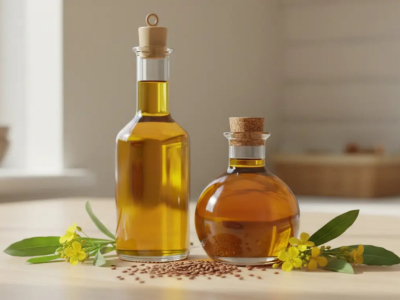

Camelina oil offers the best stability/richness in omega-3 for daily use, while flaxseed oil remains the most concentrated in ALA but requires strict storage precautions. This comparison helps you choose according to your real priorities.
With Aurélie, we have tested and offered these two oils for years in the shop. Honestly, the question keeps coming up: "Which one should I choose?" And I understand this hesitation. Two oils rich in omega-3, two different profiles, and yet a persistent confusion. So here is an honest comparison, based on our experience and the available scientific data.
Comparison: Camelina vs. Flax at a Glance
Before delving into the details, here is an overview to allow you to quickly compare these two oils:
- Omega-3 (ALA) content
- Camelina: 35-40%
- Line: 50-60%
- Vitamin E (tocopherols)
- Camelina: 56-99 mg/100g
- Lin: 40-50 mg/100g
- Oxidative stability
- Camelina: Raised
- Line: Weak
- Conservation
- Camelina: Room temperature
- Lin: Refrigerator required
- Duration after opening
- Camelina: 12-18 months
- Line: 3-6 months maximum
- Taste
- Camelina: Mild, fresh vegetables, almond
- Lin: Hazelnut, sometimes harsh
- Cooking
- Camelina: No
- Lin: No
- Indicative price
- Camelina oil: approximately €23/L
- Linen: approximately €17/L
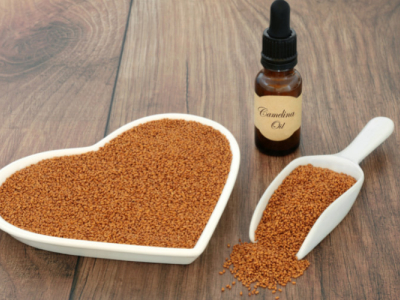
This is why we have selected an organic camelina oil grown in the Gard, cold-pressed using traditional methods. The proximity to our producers allows us to guarantee a freshness and quality that we personally verify. To learn more, Discover all the benefits of camelina oil..
.webp)
Nutritional composition: which oil provides the most omega-3 ?
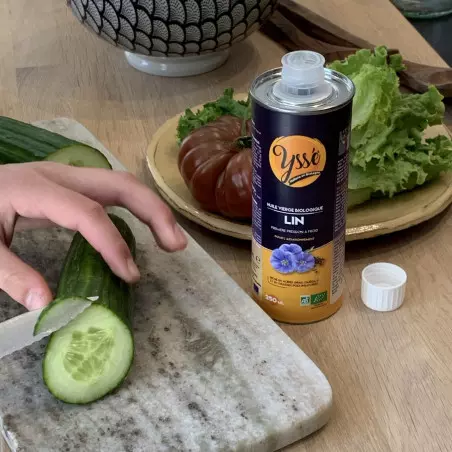
Linseed oil: the champion of omega-3s
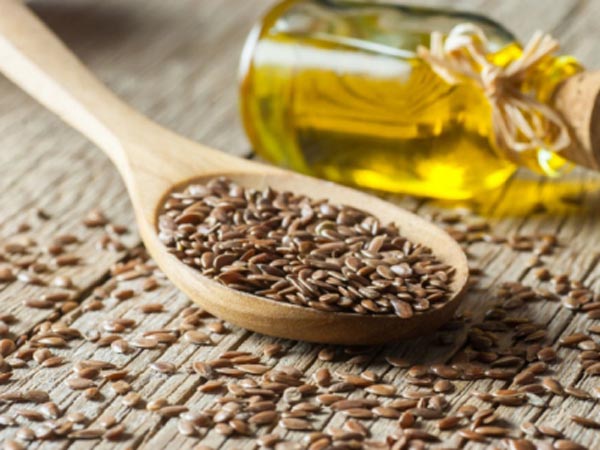
Linseed oil holds the record with 50 to 60% alpha-linolenic acid (ALA), this plant-based omega-3 that our body cannot produce. It is an exceptional concentration, difficult to match in the world of vegetable oils. To explore the topic further, check out our article on the recognized virtues of linseed oil.
In reality, 70% of French people are deficient in omega-3. according to ANSES. Our current omega-6/omega-3 ratio is around 1/20, whereas the ideal would be 1/5. Linseed oil can help rebalance this ratio due to its high ALA content.
Camelina oil: the ideal balance
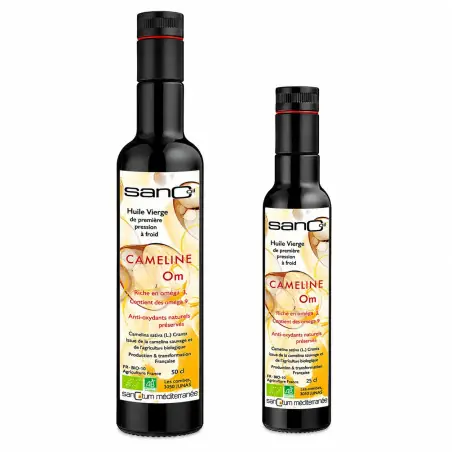
Camelina offers 35 to 40% ALA, which is remarkable. But it has a major advantage: its vitamin E content. With 56 to 99 mg of tocopherols per 100g, it contains about four times more vitamin E than flaxseed.
This vitamin E plays a key role. It helps protect cells against oxidative stress and contributes to maintaining the integrity of fatty acids. Specifically, this means that the omega-3s in camelina are better preserved over time.
Our organic camelina oil comes from the Gard region, cultivated through short supply chains. We personally know the producers and verify the cultivation and extraction conditions.
Stability and conservation: the decisive criterion
Why does linseed oil oxidize quickly ?
Here is a point that many consumers discover too late. Linseed oil, despite its exceptional richness in omega-3, has a structural weakness: it oxidizes very quickly.
Omega-3s are known as "polyunsaturated" fatty acids. The more an oil contains, the more fragile it is when exposed to air, light, and heat. Linseed oil contains so much ALA that it becomes particularly vulnerable.
Result: it must be stored in the refrigerator and consumed within the 3 to 6 months after opening. An oil of linseed that smells strong or has a bitter taste is probably oxidized. And an oxidized oil, instead of providing benefits, can generate undesirable free radicals.
Camelina: A Naturally More Stable Oil
Camelina solves this problem thanks to its balanced composition. Its high vitamin E content acts as a natural antioxidant that helps slow down the oxidation of fatty acids.
Specifically, you can keep it. 12 to 18 months at room temperature, simply away from light and heat. No need for a refrigerator, no race against time to finish it.
For us, who advise thousands of clients each year, it is a considerable practical advantage. The feedback is unanimous: 85% of our customers who have tried both oils find camelina easier to incorporate into daily life, precisely because of this reason of preservation.

Taste and use in cooking
Linseed oil: a taste that divides
Let's be honest: thelinseed oil has a pronounced nutty taste that can become harsh or bitter if it is not perfectly fresh. Some people love it, while others cannot get used to it.
This characteristic taste can dominate a culinary preparation. It should be used sparingly and the combinations should be chosen carefully.
Camelina oil: softness and versatility
The Camelina offers a much milder taste, with notes of fresh vegetables, almond, and sometimes pea. It is an oil that naturally blends into dishes without overpowering them.
Here are three usage ideas that we regularly practice with Aurélie:
- In vinaigrette, mixed with a bit of cider vinegar and mustard
- On still warm steamed vegetables, to enjoy its delicate aromas
- In a green smoothie, where it goes completely unnoticed
However, be careful: like linseed oil, camelina oil cannot withstand cooking. Its omega-3s are sensitive to heat and would degrade. Use it exclusively for cold applications or on warmed dishes.
Health benefits compared
Cardiovascular health
Both oils contribute to the normal functioning of the cardiovascular system due to their ALA content. ANSES acknowledges that omega-3s help maintain normal cholesterol levels when included in a balanced diet.
Flax provides more ALA per spoonful, but camelina offers better preservation of these omega-3s over time. Poorly stored flax oil loses some of its properties, which diminishes its initial advantage.
Digestive health and intestines
It is an area where camelina shows particular strengths. Omega-3s help support the normal functions of the intestinal mucosa. Several of our clients report better digestive comfort after regularly incorporating camelina into their diet.
Linseed oil can also support digestion, but it has contraindications for people with intestinal disorders such as obstruction. The AFSSA also advises against linseed oil for children under 3 years old.
Skin and hair
Camelina's vitamin E helps protect skin cells against oxidative stress. It is an asset for those looking to support their skin's health from within.
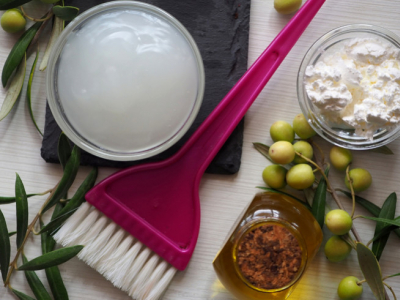
Linseed oil is also used externally for hair, particularly in homemade serums made with linseed oil. To go further, also discover our hair masks with vegetable oils. However, for dietary use aimed at enhancing skin beauty, camelina offers a more complete profile.
Which oil to choose according to your profile ?
Getting Started with Omega-3 Oils → Camelina
If you have never incorporated omega-3 rich oil into your diet, start with camelina. Its mild taste, easy storage, and versatility in cooking will allow you to develop good habits without hassle. To go further, our Guide to Choosing the Best Oils will help you build your collection.
You are looking for the maximum concentration → Lin
If you are already accustomed to omega-3 oils and want to maximize your ALA intake, flaxseed oil remains the most concentrated. Just make sure to store it in the refrigerator and consume it quickly.
You want an easy everyday oil → Camelina
For a simple integration, without worrying about preservation, camelina wins. It can be stored in your cupboard, remains stable for months, and can be used in all your cold preparations.
Our organic camelina oil from Gard meets these criteria. Cold-pressed and packaged in an opaque bottle to preserve its qualities, it is our choice for a serene daily use.
Precautions for use
Some points of caution to keep in mind:
For the camelina: Individuals on anticoagulant treatment should consult their doctor before regular consumption. Omega-3s can interact with these medications.
For linen: The AFSSA advises against this oil for children under 3 years old. It is also contraindicated in cases of intestinal obstruction or thyroid disorders. As with camelina, caution is advised if you are taking anticoagulants.
In any case, these oils are part of a varied and balanced diet. They do not replace personalized medical advice.
FAQ - Your questions about camelina and flax
What are the benefits of camelina oil ?
Camelina oil is rich in omega-3 (35-40% ALA) and antioxidant vitamin E. It contributes to the normal functioning of the cardiovascular and nervous systems. Its high content of tocopherols (56-99 mg/100g) gives it properties that help protect cells against oxidative stress.
What is the best cooking oil for the intestines ?
Camelina oil has an interesting profile for intestinal comfort due to its omega-3s, which contribute to the normal maintenance of the digestive mucosa. It can be incorporated into a diet aimed at supporting the body's elimination functions.
What oil can replace linseed oil ?
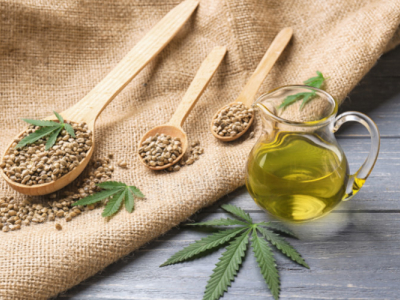
Camelina oil advantageously replaces linseed oil: it has a comparable nutritional profile, but with better stability and a milder taste. It can be stored at room temperature, unlike linseed oil which requires refrigeration. Hemp oil, another alternative, also offers a good omega-6/omega-3 ratio.
What is the oil richest in omega-3 ?
Linseed oil contains 50-60% ALA (omega-3), compared to 35-40% for camelina. However, camelina offers more vitamin E and better oxidative stability, preserving its nutrients better over time.
Is camelina oil dangerous ?
No, camelina oil is not dangerous. The only precaution: people on anticoagulants should consult their doctor before regular consumption. Keep it away from light and heat.
How to store camelina oil vs linseed oil ?
Camelina oil can be stored for 12-18 months at room temperature, away from light. Linseed oil must be kept in the refrigerator and consumed within 3-6 months after opening.
Can camelina oil or linseed oil be heated ?
No, these two oils are reserved for cold use. Their richness in omega-3 makes them sensitive to heat. Use them in dressings, on warm dishes, or in smoothies.
Our conclusion: what if you combined them ?
After years of advising our clients on these two oils, here is my belief: there is no "best" oil in absolute terms, there is the one that suits your lifestyle.
If you are looking for practicality and gentleness in your daily life, camelina will be your ally. If you want to maximize your omega-3 intake and are diligent about storage, flaxseed can complement your rotation of oils.
At Biovie, we have chosen to highlight our organic camelina oil from Gard. Not because flaxseed is bad, but because we have observed over the past 18 years that this is the oil our customers are most successful in integrating sustainably. And an oil that is actually used is better than a perfect oil that oxidizes at the back of the fridge.
Vary your oils, as we recommend in our article on why vary your oils daily. The ideal is to alternate between several sources of omega-3 to benefit from the complementary nutritional profiles.
A varied and balanced diet and a healthy lifestyle are important.