Fast delivery
.png)
 Fair prices


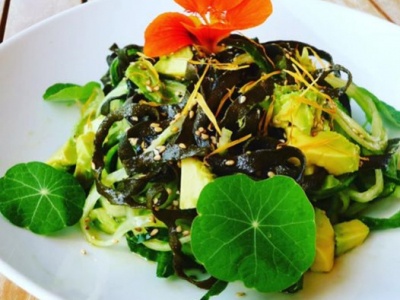

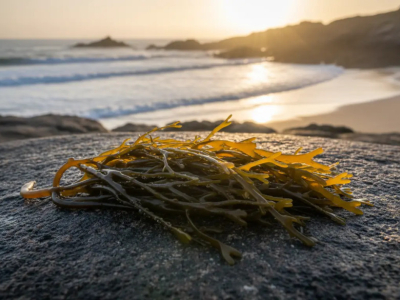
On the Breton coasts, a long brown seaweed clings to the rocks at low tide: the sea bean, also known as sea spaghetti. Its marine pasta silhouette, delicately iodized flavor, and exceptional richness in minerals make it a treasure of living food. This ultra-simple raw recipe — cucumber in spaghetti form, desalted sea bean, avocado, and sesame — reveals all the finesse of the seaweed in less than 10 minutes. Also on the menu: its benefits, proper desalting, and essential precautions regarding iodine.
What is the sea bean (Himanthalia elongata)?
The sea bean (Himanthalia elongata) is a brown seaweed from the Phaeophyceae family, which grows on the rocky coasts of the Northeast Atlantic, mainly in Brittany, Ireland, and the United Kingdom. Its thin and shiny strips, which can reach 2 to 3 meters long, have earned it the nickname "sea spaghetti" (sea spaghetti in English, Meeresspaghetti in German, spaghetti di mare in Italian).
Harvested by hand from April to August, on the foreshore at low tide, it is a seaweed from the wild coast that withstands the most powerful waves. Its common name "sea bean" simply comes from its elongated shape — it is not a legume but indeed a seaweed.
For a complete presentation of this seaweed (origin, nutritional values, cooking methods), we recommend our complete guide to sea beans.
Recipe: Raw Sea Bean with Cucumber Spaghetti (1 person)
A signature Biovie recipe, 100% raw, 100% plant-based, which is prepared in less than 10 minutes and perfectly highlights the iodized flavor of the seaweed. It's the ideal fresh starter for a summer lunch or a vibrant garnish to serve with a poke bowl.
Ingredients
- 1 organic cucumber (cut into spaghetti using a vegetable corkscrew or spiralizer)
- 1 handful (≈ 30 g rehydrated) of desalted or rehydrated sea beans
- 1 small ripe avocado (or ½ avocado) in cubes
- ½ tbsp of pumpkin seed oil (or extra virgin olive oil)
- 1 tbsp of fresh lemon juice
- 1 pinch of white and black sesame seeds
- (optional) 1 pinch of dried marigold petals, nasturtium flowers, and leaves
Step-by-step Preparation
- Desalt or rehydrate the sea beans (see the complete method below depending on whether the seaweed is dry or in brine).
- Slice the cucumber into thin spaghetti using a spiralizer (or cut into julienne with a sharp knife).
- Cut the avocado into regular cubes.
- In a bowl, gently mix the cucumber spaghetti, drained sea beans, and avocado. Drizzle with pumpkin seed oil and lemon juice.
- Sprinkle with sesame seeds and, if you have them, marigold and nasturtium petals. Serve immediately.
Variations & Pairings
- Japanese version: replace the lemon with yuzu and the pumpkin seed oil with toasted sesame oil. Add a pinch of freshly grated wasabi.
- Protein version: add 50 g of lacto-fermented tofu or crumbled tempeh.
- Mediterranean version: replace sesame with lightly toasted pine nuts and add a few fresh basil leaves.
Nutritional Benefits of Sea Beans
Sea beans concentrate a rare diversity of nutrients in the plant world. According to a scientific review published in 2023 in Foods, this seaweed has a particularly interesting profile for 3 main reasons:
- An exceptional richness in minerals: for 100 g of dry seaweed, there are typically 600 to 800 mg of magnesium, 30 to 50 mg of iron, and about 1 g of calcium (sources: Ciqual table and French seaweed industry data).
- Particular soluble fibers — alginates and fucoidans — which contribute to satiety and help balance the microbiota.
- Antioxidant compounds called phlorotannins, whose anti-inflammatory activity is the subject of several recent publications (2022 study).
Sea beans are also naturally low in calories (about 145 kcal/100 g dry) and provide 8 to 10 g of plant proteins per 100 g — an asset in a varied plant-based diet.
How to Desalt or Rehydrate Sea Beans
The preparation step determines the quality of the tasting. Depending on the form of the product (dry, in brine, or fresh), the method differs:
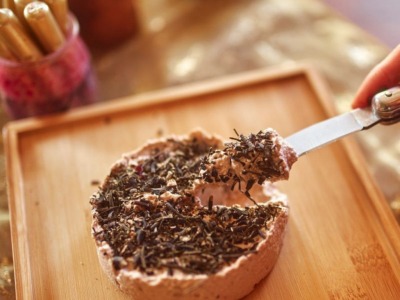
Dried (Dehydrated) Seaweed
- Place the strips in a bowl.
- Cover generously with cold or lukewarm water (never boiling: heat denatures heat-sensitive nutrients).
- Let it sit for 10 to 15 minutes.
- Rinse with clear water and drain well.
Count about 1 to 4 in volume: 30 g of dried seaweed yields about 120 g of ready-to-use product.
Fresh Seaweed in Brine
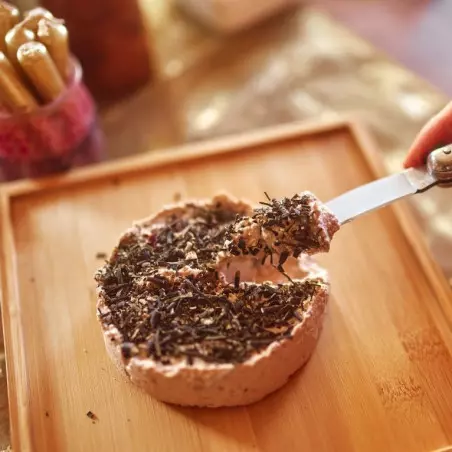
- Take the desired portion out of the jar.
- Perform 3 successive rinses with cold clear water, gently pressing between each rinse.
- Taste to check the salt balance (seaweed always retains a slight natural salinity, which is normal).
Mistakes to Avoid
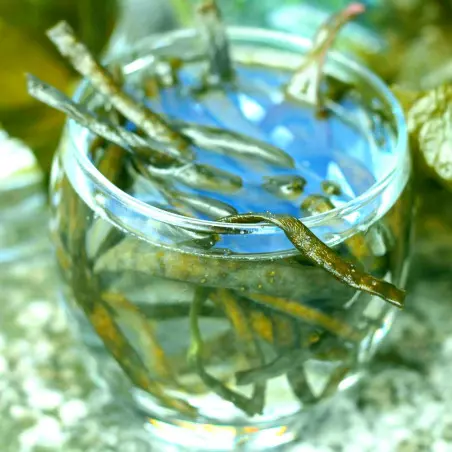
- ❌ Boiling water: destroys chlorophyll and alters bioactive compounds.
- ❌ Over-desalting (more than 30 minutes): the seaweed loses its characteristic texture and soluble minerals.
- ❌ Salting again: unnecessary, the seaweed naturally retains its marine taste.
Precautions, Iodine, and Who Should Avoid
Sea beans, like all marine seaweeds, are a food concentrated in iodine. Its consumption should be moderate. According to the recommendations of ANSES:
- Do not exceed 1 g of dry product per day for healthy adults for iodine-rich seaweeds.
- Pregnancy and breastfeeding: seek medical advice before any regular consumption (iodine needs are specific during this period).
- Thyroid disorders (hyperthyroidism, hypothyroidism, levothyroxine treatment, Hashimoto's or Graves' disease): medical supervision is essential.
- Anticoagulant treatment (vitamin K antagonists): seaweeds contain vitamin K — mention this to your doctor.
- Iodine allergy (rare): avoid.
- Children: introduce seaweeds gradually and in very small quantities.
Everyday Usage Ideas
Beyond the signature recipe above, sea beans can easily be incorporated into your everyday cooking:
- In raw tartare with dulse and hazelnuts — see our dulse and hazelnut tartare recipe.
- As a garnish for vegan bowls, poke bowls, and Buddha bowls.
- In raw makis — see our vegan makis recipe.
- In miso-tahini vinaigrette on summer raw vegetables.
- In a warm salad with celeriac or barely wilted leeks.
“Biovie's fresh seaweeds are exceptionally fresh, you can really feel the ocean.” — Marinella D., Trustpilot review ★★★★★.
To discover all French edible seaweeds, check out our complete guide to edible seaweeds.
Frequently Asked Questions (FAQ)
What is sea bean?
The sea bean (Himanthalia elongata) is an edible brown seaweed that grows on the rocky coasts of Brittany, Ireland, and the United Kingdom. Its thin and long strips have earned it the nickname "sea spaghetti." It is not a vegetable but a seaweed, rich in minerals and fibers.
How to cook sea bean?
Sea bean can be prepared both raw (in salads or tartare) and cooked (sautéed, in miso soup, in a wok). It should be desalted or rehydrated in cold or lukewarm water for 10 to 15 minutes. Avoid boiling water, which can denature its nutrients. A simple recipe: cucumber spaghetti, sea bean, avocado, lemon, and sesame.
What does sea bean taste like?
Sea bean has a fine and delicately iodized marine flavor, much milder than dulse or nori. Its texture, once rehydrated, is reminiscent of al dente spaghetti with a slight crunch. It is the ideal seaweed to discover marine flavors without confronting overly strong tastes.
How much sea bean can one eat per day?
According to ANSES recommendations, it is advised not to exceed 1 g of dry product per day for healthy adults for iodine-rich seaweeds. This corresponds to about 3 to 4 g of rehydrated product, which is a small portion as a side dish.
Is sea bean not recommended for thyroid problems?
In cases of thyroid pathology (hyperthyroidism, hypothyroidism, Hashimoto's or Graves' disease) or treatment with levothyroxine, medical advice is essential before consuming seaweeds. The high iodine content can interfere with thyroid function and certain treatments.
In Practice: Eric Viard's Opinion, Tropical Agronomist Engineer
"Sea bean is one of my favorite seaweeds to introduce the curious to living food: its spaghetti texture, subtle taste, and flexibility in cooking make it an ideal entry point. This raw cucumber-avocado recipe is the one I most often serve at home in summer: 10 minutes of preparation, freshness, and minerals in abundance. In Seaweeds Daily, we dedicate several recipes to it to show its versatility." — Eric Viard, founder of Biovie.
Update: April 2026. Article validated by Éric Viard, founder of Biovie and ISTOM engineer, co-author of "Seaweeds Daily" (Gallimard, 2024) — Best Cookbook in the World, Gourmand Cookbook Awards 2025, and Best Cookbook in France, National Culinary Academy 2025.
Disclaimer: The information presented in this article is provided for informational purposes only and does not constitute medical advice. Consult a qualified healthcare professional before making any significant changes to your diet or supplementation. As part of a varied and balanced diet and a healthy lifestyle.
Find all our organic ingredients for living food on https://www.biovie.fr/en/