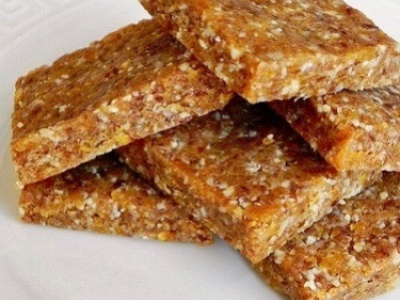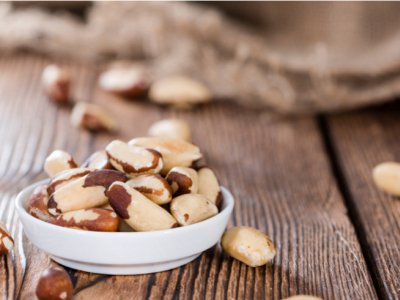

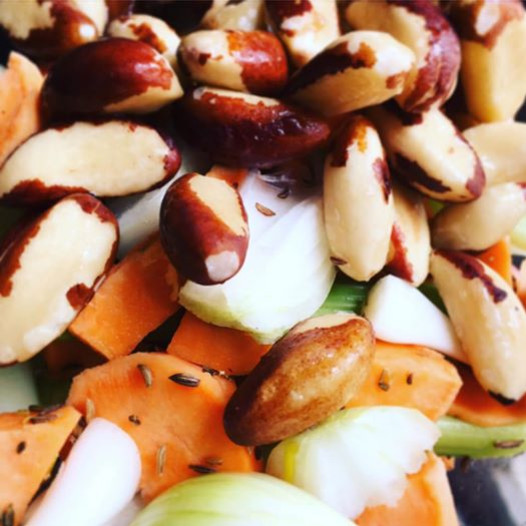

Brazil nut raw bread is much more than just a recipe: it's a culinary philosophy that combines indulgence and health. Without cooking, gluten-free, 100% raw, this recipe transforms a superfood often consumed on its own into a tasty and satisfying dish. Whether you are new to raw food or already a fan, this Brazil nut bread will delight your taste buds while providing your body with essential nutrients, including the valuable selenium.
Why this raw Brazil nut bread recipe ?
A superfood at the heart of your raw cuisine
The Brazil nut deserves its status as a superfood. Unlike other nuts, it excels due to its exceptional content of selenium — a trace element that the body cannot do without but does not produce. A single Brazil nut provides up to 100% of the recommended daily intake. This mineral richness makes it the ideal ally for vegetarians, vegans, and anyone looking to optimize their nutrition naturally.
But the Brazil nut doesn't stop there: it also contains proteins, beneficial unsaturated fatty acids (omega-6), B-group vitamins, and minerals such as magnesium and zinc. When used raw, it preserves the entirety of these nutritional treasures, unlike roasted or heated nuts.
Also discover the Benefits of Brazil nuts in our other dedicated articles.
A raw food recipe accessible to everyone
Living food often intimidates beginners. However, this raw bread recipe demonstrates that Raw food can be simple, delicious, and accessible.. No complex techniques, no rare ingredients, just a few basic utensils and time (especially for dehydration).
The raw Brazil nut bread is part of a broader vision of theliving food : respecting food in its natural state, preserving enzymes and micronutrients, and creating nourishing dishes without chemical denaturation. It is also a gateway to other raw creations, like our pear-coconut tart with Brazil nuts or our Raw chili.
Ingredients and utensils
For 4 to 6 servings
Ingredients:
- 2 cups of Brazil nut (previously soaked for a minimum of 8 hours)
- 2 cups of carrots cut into pieces
- 1/4 cup of finely chopped red onion
- 2 stalks of celery, thinly sliced
- 1 to 2 tablespoons of ground flaxseeds (optional, for texture)
- Fresh or dried herbs of your choice: thyme, oregano, cumin (1 teaspoon each)
- Sea salt: 2 pinches (adjust according to your preferences)
- Filtered water (if necessary, to adjust the consistency)
Essential utensils:
- Horizontal juicer (with the "pasta" or "blank" attachment) — ideal for preserving nutrients
- Or high-power blender (like Vitamix) as a last resort
- Sieve or strainer (to remove fibers if extracting)
- Food dehydrator (40-42 °C)
- Sharp kitchen knife
- Cutting boards (fruits/vegetables separated)
- Parchment paper layer for the dehydrator
Preparation of raw Brazil nut bread
Step 1 — Soaking the Brazil nuts (minimum 8 hours)
Start the day before or several hours before your preparation. Soaking is crucial. : it reduces phytic acid (which hinders the absorption of minerals), activates enzymes, and makes the nut easier to digest.
- Pour 2 cups of organic Brazil nuts into a glass container.
- Cover them with filtered water (use about 3 times the volume of the nuts).
- Let soak for 8 to 12 hours at room temperature (ideally 18-20 °C)
- Rinse thoroughly with clear water just before use.
- Drain well to avoid excess moisture in your dough.
Advice: If you have any doubts about the freshness of your nuts or after soaking, feel free to rinse them again. There should be no unpleasant odor.
Step 2 — Preparing the vegetables
In the meantime (or just before starting), prepare your vegetables:
- Carrots: Peel lightly (keep the thin skin rich in nutrients), cut into pieces of 2-3 cm.
- Red onion: Peel, divide into 4, then finely chop
- Celery: Clean, remove the first fibrous layers, slice into small pieces.
- Set aside in a bowl
The red onion brings a taste subtlety and interesting sulfur compounds (quercetin). Celery enriches the dough with minerals and a sweet, slightly salty flavor.
Step 3 — Transfer to the juicer or blender
Method with horizontal extractor (recommended):
- Position the "pasta" or "white" accessory (for purees)
- Start with soaked and drained Brazil nuts
- Then alternate vegetables: carrots, onion, celery
- Retrieve the thick paste in a bowl; the juice (small glass) can be used for a smoothie or composted.
- Mix the dough well by hand to make it uniform.
Method with blender:
- Pour nuts and vegetables in successive portions
- Pulse until you achieve a grainy texture (not smooth or powdery).
- Transfer to a fine sieve and press lightly with the back of a spoon to remove as much excess moisture as possible.
Finishes:
- Pour the batter into a large bowl
- Add the ground flaxseeds (if used), the herbs, the salt
- Knead by hand for 1-2 minutes to mix well and "awaken" the flavors.
- Taste and adjust the seasoning: salt, herbs, or a pinch of chili if you like it.
Step 4 — Shaping and Dehydration
Here is the decisive step that transforms your preparation into real bread:
- Cover the trays of your dehydrator with parchment paper.
- Roll out the dough into an even layer about 1.5-2 cm thick.
- Smooth with a moistened spatula (the moisture from your finger is also sufficient)
- Set the dehydrator to 40-42 °C — key temperature to preserve enzymes
- Dehydrate for 8 to 12 hours according to your dehydrator and the ambient humidity
- Around the 6th hour, you can remove the parchment paper if the top appears sufficiently dry, or leave it and flip the dough over in one go.
- Continue until you achieve a texture crispy on the outside, slightly tender on the inside
The bread is ready when it is no longer sticky and breaks slightly under the finger, but remains pliable (not brittle like a stone).
Conservation and service
- Fees: at room temperature in an airtight container, for up to 5-7 days
- Refrigerated: up to 2 weeks in a closed glass container
- Frozen: up to 1 month in a suitable freezer bag
- Service: Cut into squares or sticks, enjoy plain or with homemade hummus, cashew cream, or as a side to a fresh salad.
Nutritional benefits of Brazil nuts
Selenium: An Essential Trace Element
This is the true power of the Brazil nut. Selenium is a indispensable cofactor for antioxidant enzymes (glutathione peroxidase, thioredoxin reductase), which neutralize free radicals and reduce oxidative stress.
According to the study by Thomson et al. (2008, PubMed), The consumption of a single Brazil nut per day significantly improves selenium status in selenium-deficient adults.. A more recent meta-analysis by Cardoso et al.2022, PMC) confirms that selenium from Brazil nuts contributes to the improvement of lipid markers, the reduction of oxidative stress, and systemic inflammation.
For the vegetarians and vegans, this richness in selenium is particularly interesting: the Brazil nut becomes one of the best alternative sources to meat or seafood.
Important: Selenium follows the dose-response law. More is not better. We will return to this in the precautions section.
Key vitamins and minerals
Beyond selenium, Brazil nuts provide:
- Vitamin E (tocopherols): A fat-soluble antioxidant that protects cell membranes
- Magnesium: key mineral for muscle relaxation, regulation of heart rhythm, and sleep
- Zinc: essential for immunity and healing
- Calcium: much less concentrated than in dairy products, but biologically available
- Monounsaturated and polyunsaturated fatty acids (omega-6): contribute to a favorable lipid profile
- Soluble fibers: support digestive health and satiety
The study by Colpo et al. (2013, PMC) showed that a Sole consumption of Brazil nuts rapidly improves the lipid profile, notably by reducing oxidized LDL.. This immediate anti-inflammatory effect is one of the most remarkable properties of this oilseed fruit.
Benefits of raw and living foods
Cooking Brazil nuts — even at low temperatures — partially destroys the vitamins (especially E) and natural enzymes. By keeping them raw, you preserve:
- Natural digestive enzymes that facilitate the assimilation of nutrients
- Bioavailability minerals and vitamins
- Phytochemical compounds fragile (flavonoids, carotenoids) of carrots and celery
Discover more about the Benefits of raw foods and how to integrate them into your daily life. Raw bread is actually an excellent starting point for a raw breakfast Balanced.
Precautions and dosage
If the benefits of Brazil nuts are real, moderation remains key. Here's why:
Selenium content — beware of overdose
Selenium, beneficial in appropriate doses, can become toxic in excess. The upper safety limit is estimated at 400 μg per day In adults. However, a single Brazil nut already contains 90-120 μg. Consuming 3-4 nuts daily would exceed this limit, risking a chronic selenosis (brittle nails, hair loss, tremors).
Recommendation: Limit your consumption of Brazil nuts to 1 to 3 whole nuts per day, or incorporate this raw bread recipe 2 to 3 times per week (4-6 servings/shared preparation), rather than daily.
Another concern: radium
Brazil nuts naturally accumulate radium from the soil, particularly in the Amazon. A recent study (Koeder C et al., 2025) documents this bioaccumulation, but the levels remain well below the dangerous radioactivity thresholds established by health authorities. Favoring the Organic and certified Brazil nuts (like those offered at Biovie) further limits this risk.
For vegans: selenium absorption
A clinical trial 2025PubMed) shows that the selenium from pure Brazil nut butter is better absorbed than that from an isolated supplement in vegans. This raw bread, combining Brazil nuts, carrots, and vegetables, therefore offers a excellent bioavailability thanks to the nutritional synergy of whole ingredients.
Warning for children
Children have lower selenium needs (15-20 μg/day compared to 55 μg for adults). Adjust portions according to age. Find out how introduce children to raw food in a playful and safe manner.
FAQ — Frequently Asked Questions about Brazil nuts and raw bread
Can I use a regular blender instead of a juicer ?
Yes, although the horizontal extractor is ideal. With a regular blender, pulse rather than blend continuously (to avoid overheating), and use a fine strainer to remove excess moisture before dehydration. The result will be very similar, with a slightly finer texture.
How long does raw bread last once dehydrated ?
At room temperature in an airtight container: 5 to 7 days. In the refrigerator: 2 to 3 weeks. In the freezer: up to 1 month. The drier and cooler the environment, the longer the storage will be. Check for any odor or mold before consumption.
Can Brazil nuts be replaced with other nuts ?
Technically yes, but you will lose the unique richness in selenium. You could try the raw cashews (softer, creamier), common almonds or walnuts. Adjust the soaking and dehydration times according to the desired result.
Should I soak Brazil nuts if they are already shelled ?
Yes, even shelled kernels benefit from soaking: reduction of phytic acid, enzymatic activation, and better digestibility. 6 to 8 hours are usually sufficient. After soaking, you can even consume them on their own if you prefer.
What are the best accompaniments to serve with this raw bread ?
The raw savory bread pairs perfectly with homemade hummus, a spiced cashew cream, avocado puree, or as a topping for a crudité platter with fresh sprouts and tahini sauce. You can also incorporate it into a raw pastry by crumbling it over a raw layered cake.
Can this bread be prepared without a dehydrator ?
It is more difficult, but possible. You can use an oven at a very low temperature (35-40 °C, door slightly ajar) for 12-16 hours, making sure to monitor it to avoid accidental cooking. The low-temperature oven preserves enzymes better than standard cooking, but a dehydrator remains ideal for raw food.
Variants and inspirations
Once the recipe is mastered, explore these variations:
- Sweet raw bread: Replace onion and herbs with macerated dates, cinnamon, and macadamia nuts. Serve as a sweet snack or pastry base.
- Raw bread "Mediterranean": Keep the basic proportions but add pitted olives, rehydrated sun-dried tomatoes, and fresh basil. A marvel on a crudité platter.
- Protein raw bread: Increase the flaxseeds, add shelled hemp seeds, and a little organic spirulina (1 teaspoon). Ideal after sports or for an energizing breakfast.
In practice: the opinion of Eric Viard, tropical agronomist engineer
"The Brazil nut is one of the most complete nuts I know. In our living kitchen at Biovie, we regularly use it for its richness in selenium and its exceptional nutritional profile. This raw bread is a perfect example: a simple, no-cook recipe that preserves the integrity of the nutrients. With Aurélie, in our book 'Seaweed for Everyday Use,' we share this philosophy of living cuisine that respects food and truly nourishes the body." — Eric Viard, founder of Biovie.
Update: April 2026. Article approved by Éric Viard, founder of Biovie and engineer ISTOM, co-author of " Seaweed in everyday life "(Gallimard, 2024) —" Best cookbook in the world, Gourmand Cookbook Awards 2025, and Best cookbook in France, National Academy of Cuisine 2025.
Warning: The information presented in this article is provided for informational purposes only and does not constitute medical advice. Consult a qualified healthcare professional before making any significant changes to your diet or supplementation. As part of a varied and balanced diet and a healthy lifestyle.
Find all our organic ingredients for raw food on https://www.biovie.fr/en/. Check out our range of organic Brazil nuts to start this recipe with confidence.